
Five Mistakes People Make When Buying a Sauna Kit

The five most common sauna kit buying mistakes are sizing by floor space instead of interior cubic footage, ordering before confirming electrical capacity, choosing wood heat without checking clearance and permit rules, buying on sticker price alone without checking wood species and drying process, and skipping proper drainage under the base. Each one shows up repeatedly in returns and complaints, and each one is avoidable with about twenty minutes of checking before placing an order. None require special expertise, just a short pause between finding a listing that looks appealing and actually clicking buy.
Mistake 1: Sizing the Kit by Floor Space Instead of Cubic Footage
A couple shopping for a backyard sauna kit compared two listings side by side, both described as five feet by six feet, and assumed the heater requirements would be identical. One had an 8-foot peaked ceiling, the other a flat 7-foot ceiling, a difference that changes the interior cubic footage, and therefore the correct heater size, by a meaningful margin. They ordered based on the smaller heater listed for the flat-ceiling model and installed it in the peaked-ceiling unit, which then struggled to hold temperature on cold evenings. Heater sizing charts are built around cubic footage, not the floor dimensions printed in bold on a listing page, and skipping that distinction is the single most common reason a new sauna kit underperforms.
Mistake 2: Ordering Before Confirming Electrical Capacity
A homeowner ordered a traditional cabin kit with a 6-kilowatt heater, assuming an electrician could simply run a new circuit once the kit arrived. The home’s panel turned out to be at capacity, and adding a subpanel to support the new circuit added several weeks and a cost the buyer had not budgeted, all while a sauna kit sat on pallets in the garage. A five-minute call to an electrician before ordering, just to confirm panel capacity and get a rough cost for a dedicated circuit, would have avoided the delay entirely and let the buyer choose an infrared model instead if the electrical work looked too expensive.
Mistake 3: Choosing Wood Heat Without Checking Clearances
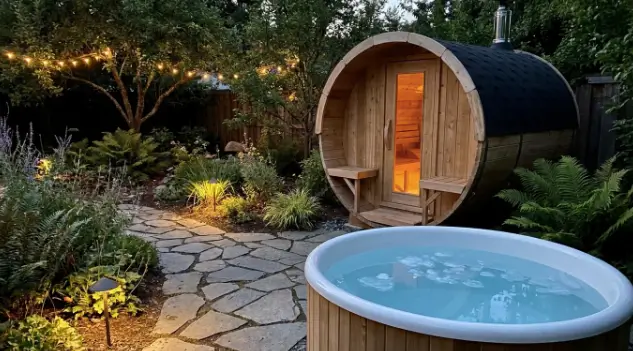
A buyer with a narrow side yard ordered a wood-fired barrel kit because of the lower upfront electrical cost, only to discover during permitting that the required chimney clearances from the property line and the house wall did not fit the available space. The kit ended up in a different corner of the yard than originally planned, with a longer walk from the back door that reduced how often it actually got used. Wood-fired heat looks appealing on price alone, but the combustion clearances it requires can rule it out in a tight lot before cost ever becomes the deciding factor, which is worth checking against the property’s actual dimensions first, ideally with a tape measure in hand rather than a rough guess from memory.
Mistake 4: Buying on Price Alone Without Checking Wood and Drying
A shopper compared three barrel kits at similar price points and picked the cheapest, assuming cedar was cedar regardless of brand. The kit arrived with panels that had not been fully kiln-dried, and gaps opened between boards within the first two months of regular heater use, letting warm air escape and creating an ongoing feeling of never getting the room fully hot. Comparing wood species and drying process, not just price per square foot, across current listings such as sweatdecks.com and other specialty retailers is worth the extra half hour before ordering, since a listing that states only “premium cedar” without naming a drying process is a common warning sign worth asking about directly.
Mistake 5: Skipping Drainage Under the Base
A family set their new cabin kit directly on packed dirt in a low corner of the yard that collected runoff after every rainstorm, assuming the pressure-treated base would hold up regardless. Within a year, the bottom edge of several wall panels had begun to soften and darken from sitting in standing water after wet weeks, and by the second spring two panels needed replacement, an expense and a delay that a proper base would have avoided entirely. A base that drains, whether a gravel pad, a paver bed, or a raised deck platform, costs a few hundred dollars and a weekend to build properly, and it is far cheaper than replacing rotted panels on a kit that is otherwise only a year or two old.
What Do These Mistakes Have in Common?
Every one of them is a planning problem, not a product defect, and every one is preventable with a tape measure, a phone call, and a few careful questions to the seller. The kits themselves, when built from kiln-dried wood with a correctly sized heater, hold up well for years, which reviews of sauna construction and use broadly support when discussing well-maintained units. A 2018 review in the American Journal of Physiology and a related review in Mayo Clinic Proceedings both describe sauna use in the context of consistent, long-term habits, which only happens when the physical setup, size, siting, and drainage, actually works for the space it sits in. A 2023 follow-up review reinforced that the value people report from regular use depends on the habit sticking, and a kit undermined by one of these five mistakes is far less likely to get used consistently in the first place.
Frequently Asked Questions
What is the most common mistake when buying a sauna kit? Sizing the kit by floor space rather than interior cubic footage, which leads to an undersized or oversized heater. The second most common mistake is ordering before confirming the site’s electrical capacity, which can delay installation by weeks.
Can you return a sauna kit if it does not fit the space? Return policies vary widely by manufacturer, and many charge a restocking fee plus return shipping on a bulky kit, which can run several hundred dollars. Measuring the site carefully before ordering avoids this cost entirely.
Do all sauna kits use kiln-dried wood? No. Lower-cost kits sometimes use wood that was not fully kiln-dried, which is more likely to warp or develop gaps once the heater starts cycling. A legitimate listing states both the wood species and the drying process, not just the species alone.
Why does drainage matter for a sauna kit’s foundation? Standing water under or against a wood kit accelerates rot and can void a manufacturer’s warranty. A base that drains water away, rather than letting it pool against the wood, is one of the cheapest ways to protect a kit’s lifespan.
References
- Effects of heat and cold on health, with special reference to Finnish sauna bathing, American Journal of Physiology, 2018
- Cardiovascular and Other Health Benefits of Sauna Bathing: A Review of the Evidence, Mayo Clinic Proceedings, 2018
- Does the Combination of Finnish Sauna Bathing and Other Lifestyle Factors Confer Additional Health Benefits? A Review of the Evidence, Mayo Clinic Proceedings, 2023
By Laurel Kimmel